
The Judicial Reform Nobody Wanted, but Everyone Is Getting
When Claudia Sheinbaum took office on October 1, 2024, she inherited not merely a government but a constitutional situation that would have tested even the most seasoned administrator. Her predecessor, Andrés Manuel López Obrador, had rammed through a sweeping judicial reform that mandated the popular election of all federal judges beginning in 2025. This was not a minor procedural adjustment. It amounted to a fundamental restructuring of Mexico’s judiciary, including the wholesale replacement of all 11 Supreme Court justices through staggered popular elections commencing in June 2025. To understand why this matters: the Supreme Court had historically possessed meaningful independence. In its institutional lifetime, it had struck down 22 constitutional amendments. That check on executive power was being dismantled not by Sheinbaum herself, but by the political momentum she inherited.
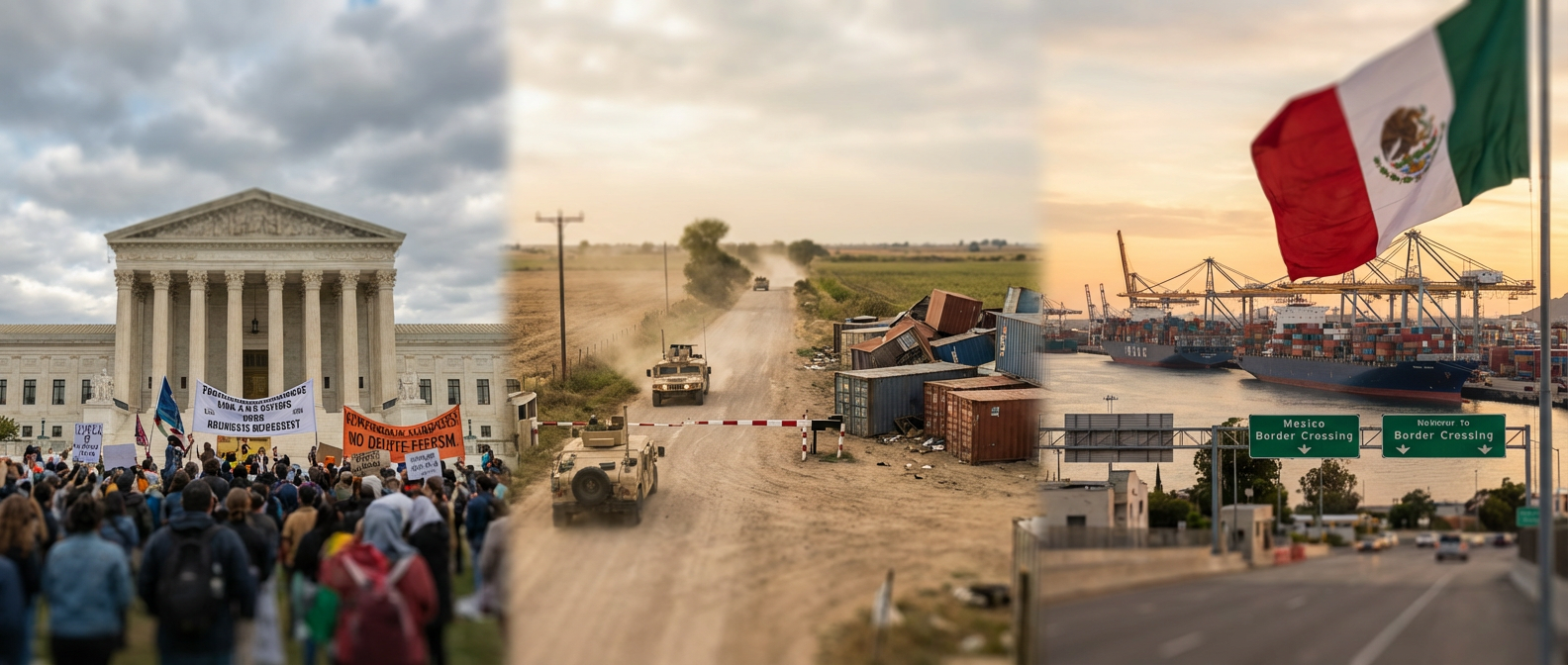
The reform triggered something close to institutional revolt. Federal judges staged historic protests. The judicial branch, facing its own obsolescence under the new system, pushed back with the limited tools at its disposal. Yet by the time Sheinbaum arrived, the constitutional machinery was already in motion, largely irreversible. She did not design this reform, but she would bear its consequences. The political dilemma became immediately apparent: she could either defend judicial independence and distance herself from her party’s radical restructuring, or she could embrace it and accept the legitimacy question that followed. She chose something closer to the latter, framing it as democratic renewal while quietly managing the institutional chaos beneath.
What makes this situation intellectually interesting is that Sheinbaum faced genuine philosophical complexity, not mere political theater. The argument for judicial democratization contains real force: why should unelected justices, appointed through opaque processes, hold life tenure over constitutional questions? That is not a foolish question. But the counter-argument also holds force: popular elections for judgeships tend to produce judges who are accountable to public opinion rather than to law, which is precisely what judicial independence is meant to prevent. Sheinbaum inherited a reform that embodied one side of this genuine tension, and she had to govern through the contradiction.
The Tariff Crisis and the Sovereignty Question
Then came the tariffs. In early 2025, the Trump administration imposed 25 percent levies on Mexican goods, invoking the International Emergency Economic Powers Act and citing fentanyl trafficking as justification. The legal basis for this move was fundamentally different from standard trade disputes. By framing the tariffs as a national security matter rather than a commercial disagreement, the Trump administration essentially declared that Mexico’s security performance was so inadequate as to constitute a direct threat to American welfare. This was a sovereignty claim masquerading as a trade measure.
Sheinbaum faced an immediate calculation: capitulate and accept the implicit humiliation of being told your country is a security liability, or resist and risk economic devastation. She chose to negotiate seriously, and the emergency bilateral discussions produced a partial suspension of the tariffs for goods that complied with United States-Mexico-Canada Agreement standards. Not a victory, but not a rout either. The structure of the agreement, however, meant that Mexico’s trade access now depended on demonstrating performance against drug trafficking to American satisfaction. The bar for that performance was moving, and it was moving upward.
The intellectual trap here is subtle. Sheinbaum could not simply solve the fentanyl problem through effort and will. The fentanyl crisis is structurally rooted in Mexican geography, the fragmentation of cartels, the permeability of borders, and ultimately, American drug demand. Yet she would be held responsible for metrics she did not fully control. This is how asymmetrical power relationships work in practice: Mexico must demonstrate compliance while the United States maintains the authority to determine whether compliance is satisfactory.
The Cartel Designation and the Diplomatic Minefield
By early 2025, the U.S. State Department moved to designate multiple Mexican cartels as Foreign Terrorist Organizations. This was not a mere rhetorical escalation. The FTO designation carries material consequences: it criminalizes material support to designated groups, it enables broader surveillance authorities, and it reframes Mexican criminal organizations as terrorism rather than narcotrafficking enterprises. From Washington’s perspective, this was a logical escalation given the sophistication and lethality of cartel operations. From Mexico City’s perspective, it was a sovereignty violation dressed in counterterrorism language.
Sheinbaum’s government formally rejected the designations. The argument was straightforward: Mexico’s internal security challenges are not a terrorism problem requiring American military-legal frameworks; they are a law enforcement problem requiring Mexican solutions. This was not mere nationalist bluster. There is a genuine legal and philosophical distinction between criminal enterprises and terrorist organizations, and applying the terrorism rubric to Mexican cartels would implicitly validate American intervention in Mexican affairs under counterterrorism authorities. The Sheinbaum administration understood this distinction and pushed back hard.
Yet the rejection also revealed the limits of Mexican leverage. The designations proceeded anyway. This meant that American law enforcement could pursue Mexican cartel leadership with tools designed for international terrorism, that intelligence sharing became more complicated, and that the implicit threat of unilateral American action in Mexican territory grew more explicit. Sheinbaum had asserted Mexican sovereignty and lost. This is the difficult position of a medium-sized power adjacent to a superpower: you can articulate principles, but enforcement remains asymmetrical.
The Security Statistics Game
Underlying all of this was a data problem. Mexico’s homicide rate remained among the world’s highest, at approximately 24 deaths per 100,000 inhabitants according to 2024 official statistics. That number is staggering in comparative terms: the United States rate hovers around 6 per 100,000. Yet Sheinbaum’s government contested the methodologies behind these figures and claimed genuine security improvements in certain regions. This was not dishonesty, exactly. Violence is genuinely uneven across Mexican geography. Some areas had improved. But globally, Mexico’s security situation remained catastrophic by any reasonable standard.
The political trap is obvious: Sheinbaum needed to show results to maintain credibility both domestically and internationally, yet the underlying drivers of violence were largely unchanged. The cartels were fractured but not weaker. Drug demand in the United States remained constant. Border permeability persisted. She could improve statistics through better reporting mechanisms, through genuine targeted operations, or through creative redefinition of what counts as success. But she could not transform Mexico’s fundamental position in the global drug economy through policy alone, and everyone understood this.
Governing Through Contradiction
What strikes an observer about Sheinbaum’s position is how thoroughly it resists clean resolution. She did not create the judicial reform, but she must implement it. She did not cause the fentanyl crisis, but she must respond to tariffs imposed because of it. She did not establish Mexico’s geography or the cartels’ sophisticated logistics, but she must demonstrate security performance to skeptical American overseers. She inherited a situation where the available choices were all constrained by prior decisions and structural factors largely outside her control.
This is the opposite of the kind of crisis that admits of heroic leadership. There is no decision she can make that resolves all three problems simultaneously. The judicial reform strengthens presidential authority while weakening institutional checks, which might help with security but undermines democratic legitimacy. The tariff negotiations buy time but enforce Mexican dependence on American satisfaction. The security situation improves slowly, if at all, regardless of policy intensity. Sheinbaum must navigate all three crises while managing the contradictions between them.
Those seeking detailed analysis of Sheinbaum’s policy approach can find substantive material through the Mexican Government Official Policy Portal, which documents her administration’s initiatives directly. For deeper institutional context and expert assessment of these overlapping challenges, the Wilson Center Mexico Institute Analysis provides rigorous scholarly perspective on how these crises interact.
The real question for observers is whether Sheinbaum can manage these contradictions without allowing any single crisis to overwhelm her capacity to govern. Early signs suggest a pragmatist at work: she accepts what she cannot change, negotiates on what she can influence, and attempts to maintain institutional stability even when the institutions themselves are being restructured. Whether this proves sufficient is genuinely uncertain. The next eighteen months will tell us whether someone can govern Mexico effectively under these constraints, or whether the trilemma proves too severe.