
The Historical Precedent for State Innovation
Justice Louis Brandeis famously described states as “laboratories of democracy” in his 1932 dissent in New State Ice Co. v. Liebmann, but the concept he articulated had deep roots in the American constitutional framework. The founders, particularly those who championed federalism like James Madison, envisioned a system where states would be testing grounds for policy innovation, allowing successful experiments to be adopted elsewhere while failed policies remained contained. This vision assumed that state legislatures would maintain robust policymaking capacity and that meaningful policy variation between states would persist over time.
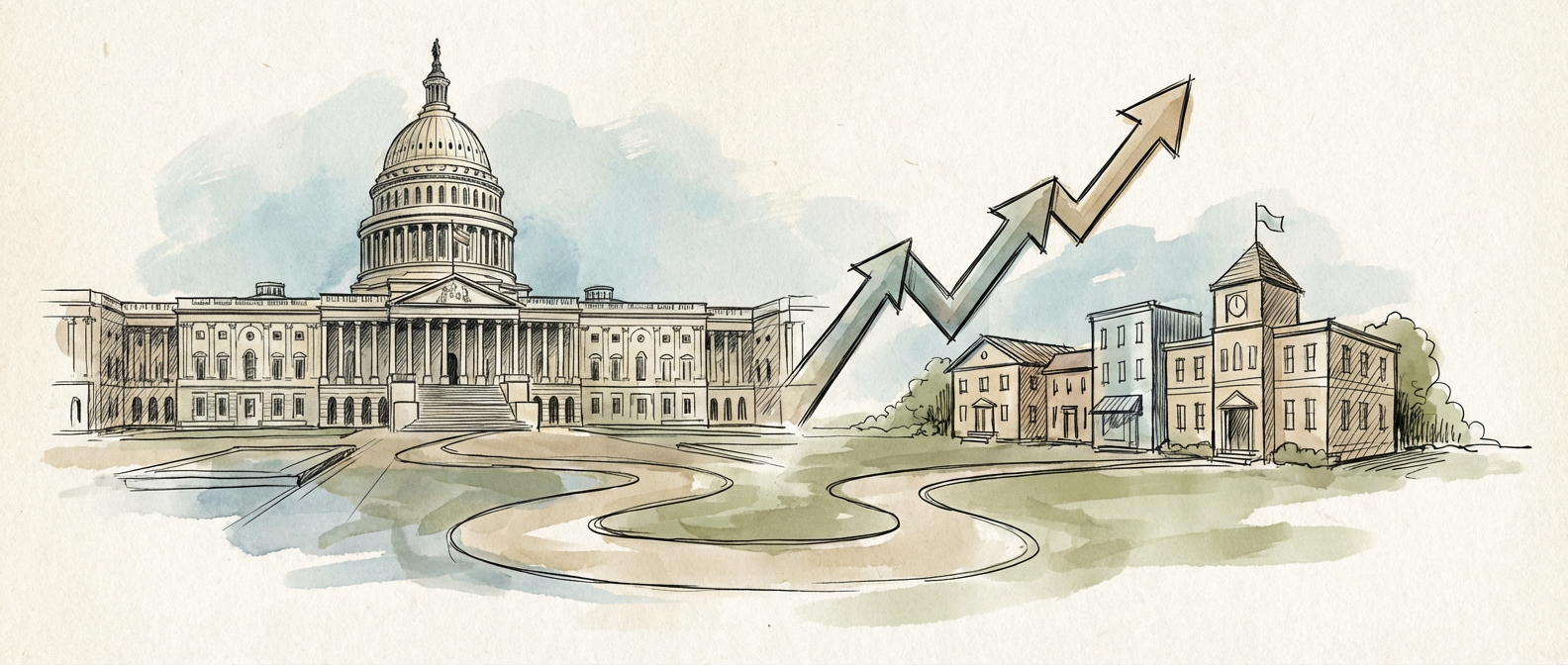
What Brandeis could not have anticipated was the dramatic centralization of policy authority that would occur over the next few decades. The New Deal, Great Society programs, and various federal mandates gradually shifted the focus of policy innovation from state capitols to Washington, D.C. By the 1970s, many state legislatures had become what political scientist Alan Rosenthal termed “reactive institutions,” primarily focused on implementing federal directives rather than crafting original solutions to governance challenges.
The current moment is a fascinating historical parallel to the period immediately following the ratification of the Constitution, when states exercised broad policy discretion within their spheres of authority. Today’s state legislatures are reasserting their constitutional prerogatives across multiple policy domains, from education and healthcare to criminal justice and economic development. This resurgence reflects both the practical limitations of federal policymaking in an era of congressional gridlock and a deeper philosophical return to the federalist principles that animated the founding generation.
Contemporary Manifestations of State-Led Governance
The evidence for this state-level renaissance appears across numerous policy areas, but perhaps nowhere more clearly than in the different approaches states have taken to marijuana legalization, minimum wage policy, and healthcare expansion. These policy domains illustrate how states are once again genuine laboratories, producing measurably different outcomes that provide valuable data for other jurisdictions. Colorado’s cannabis legalization experiment, for instance, generated real-world evidence about tax revenue, public health outcomes, and administrative challenges that informed subsequent policy decisions in other states.
Similarly, the patchwork of state minimum wage policies has created natural experiments that economists can analyze to understand the employment effects of wage mandates. States like Washington and California have implemented substantially higher minimum wages than federal law requires, while others have maintained the federal standard, providing researchers with variation that would be impossible to achieve through federal policy alone. This policy divergence mirrors the 19th-century period when states pioneered workplace safety regulations, child labor laws, and public health initiatives that eventually influenced national policy.
The healthcare arena presents perhaps the most complex example of contemporary laboratory federalism. The Affordable Care Act’s Medicaid expansion provision created an opportunity for states to make genuine policy choices with significant fiscal and human consequences. The resulting variation in expansion decisions has generated substantial data about the effects of expanded healthcare access on state budgets, health outcomes, and economic development patterns. States that expanded Medicaid have seen different trajectories in hospital closure rates, rural healthcare access, and uncompensated care costs compared to non-expansion states.
The Institutional Capacity Challenge
However, the parallel between contemporary state activism and the early republican period faces significant limitations rooted in changes to the institutional structure of American governance. Early state legislatures operated in an environment with limited federal oversight, minimal interest group activity, and relatively simple policy challenges. Today’s state legislators must navigate complex federal regulatory frameworks, sophisticated lobbying operations, and policy problems that often transcend state boundaries.
The professionalization of state legislatures since the 1960s has created institutions with greater analytical capacity and longer legislative sessions, but it has also introduced new constraints. Term limits in some states have reduced institutional memory and expertise, while increased partisan polarization has made bipartisan policy innovation more difficult to achieve. The National Conference of State Legislatures reports that average tenure for state legislators has declined significantly since the 1990s, potentially undermining the deep policy knowledge required for effective innovation.
Moreover, the fiscal constraints facing many states limit their ability to pursue ambitious policy experiments. Unlike the federal government, states cannot engage in deficit spending during economic downturns, and their revenue systems often depend heavily on volatile income and sales taxes. These structural limitations mean that state policy innovation must occur within tighter fiscal parameters than existed during earlier periods of active state governance.
Interstate Learning and Policy Diffusion
One area where the historical parallel proves particularly instructive involves the mechanisms through which successful state innovations spread to other jurisdictions. In the 19th century, policy diffusion occurred primarily through informal networks of legislators, governors, and reform advocates who shared information about successful programs. The development of workers’ compensation laws, for example, spread from state to state through a combination of advocacy group pressure and interstate communication about policy outcomes.
Contemporary policy diffusion operates through more sophisticated but arguably similar channels. Organizations like the Council of State Governments, the American Legislative Exchange Council, and the State Innovation Exchange facilitate rapid information sharing about policy innovations and their implementation challenges. The speed of modern communication means that successful policies can be identified, analyzed, and adapted much more quickly than in previous eras, but the basic pattern of interstate learning remains consistent with historical precedent.
The emergence of regional policy compacts and interstate agreements also echoes earlier periods of state cooperation. The Regional Greenhouse Gas Initiative, for instance, represents the kind of interstate collaboration that characterized 19th-century efforts to address shared challenges like transportation infrastructure and public health emergencies. These modern compacts suggest that states retain the capacity for cooperative policymaking even with increased federal involvement in many policy domains.
Implications for Democratic Governance
The resurgence of state-level policy innovation carries important implications for the health of American democratic institutions. At its best, laboratory federalism allows for policy experimentation that can improve governance outcomes while maintaining democratic accountability through state-level elections. Citizens who disapprove of their state’s policy direction retain the option to relocate to jurisdictions with more appealing policy environments, creating a form of competitive federalism that can incentivize good governance.
However, this competitive dynamic also raises concerns about inequality and democratic access. Policy variation between states can create significant disparities in citizen welfare depending on residential location, potentially undermining the principle of equal treatment under law. The historical record suggests that these tensions are inherent to federalist systems and cannot be fully resolved through institutional design alone.
The current period of state activism also reflects broader changes in American political culture, including decreased trust in federal institutions and increased partisan polarization. While these trends present challenges for democratic governance, they also create opportunities for state-level institutions to rebuild public trust through effective policy implementation and responsive governance. The ultimate success of contemporary laboratory federalism will depend on whether state institutions can deliver measurably improved outcomes for their citizens while maintaining democratic legitimacy and accountability.
Understanding these dynamics requires close attention to both the historical precedents that inform current developments and the unique features of contemporary governance challenges. What patterns do you observe in your own state’s policy innovations, and how do they compare to developments in neighboring jurisdictions?